

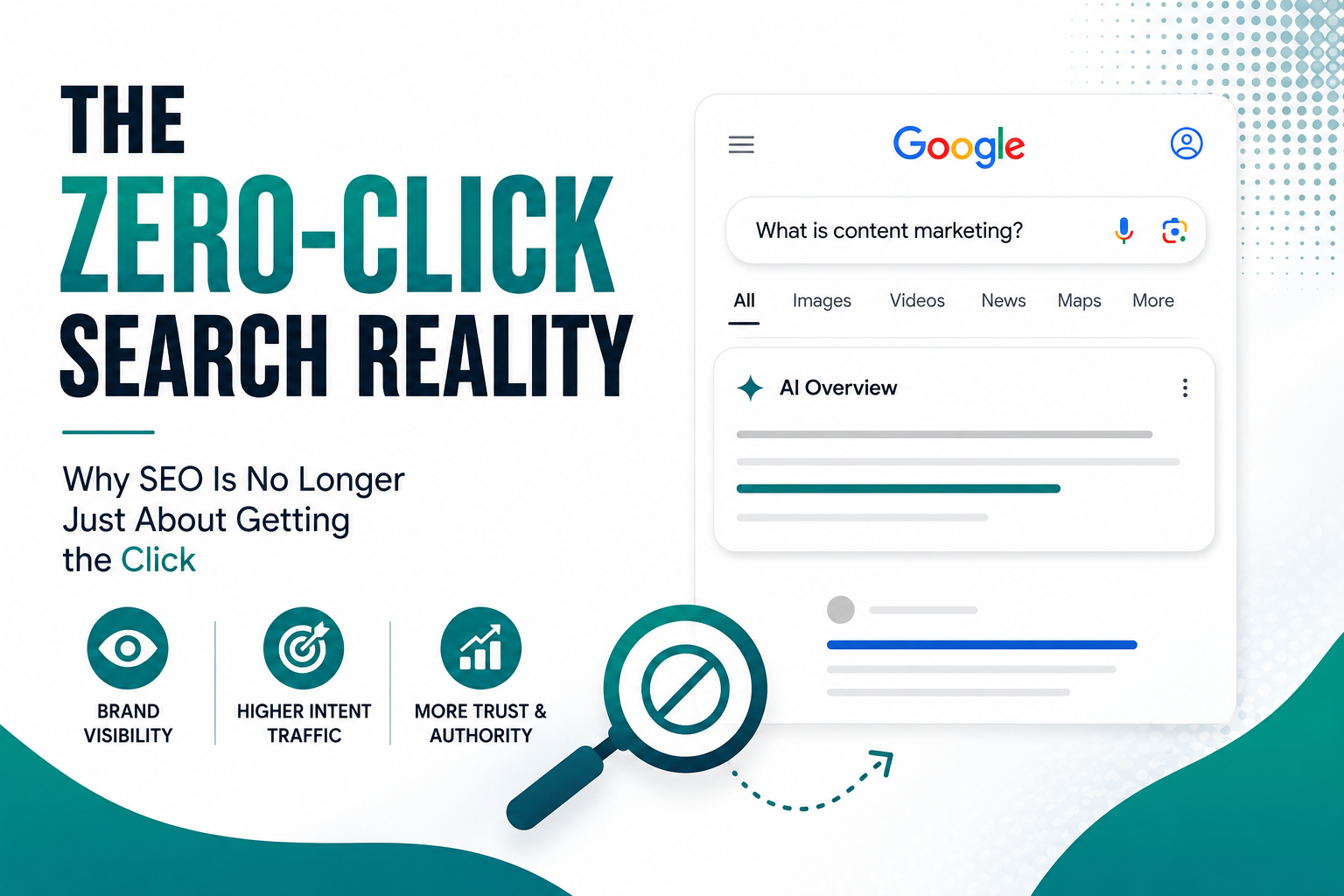
The “Zero-Click” Search Reality: Why SEO Is No Longer Just About Getting the Click 🔎
For years, the goal of search engine optimization seemed simple:
Get to the first page of Google. Get the click. Bring the visitor to your website. Convert them into a customer.
But search is changing.
Today, someone can search for a question on Google, find the information they need directly on the results page, and never visit a single website.
This is the reality of zero-click search.
Google is increasingly designed to answer questions directly through features such as featured snippets, knowledge panels, “People Also Ask,” local results, and AI-generated search experiences.
For businesses, marketers, bloggers, and SEO professionals, this creates an important question:
If people don’t click, how do you still win the search?
The answer is simple:
Stop optimizing only for the click. Start optimizing to become the answer.
What Is a Zero-Click Search?
A zero-click search happens when a person searches for something on a search engine but gets the information they need without clicking through to another website.
For example, someone might search:
“What is content marketing?”
Instead of scrolling through several websites, Google may display a definition directly in the search results.
The user gets their answer.
No click.
No website visit.
No pageview.
From a traditional SEO perspective, that might sound like a loss.
But it doesn’t necessarily have to be.
Your brand can still appear in that answer.
And that changes the definition of what it means to win in search.
Search Visibility Is Bigger Than Website Traffic
Website traffic is still important.
But traffic is only one part of the SEO equation.
Think about how people make decisions online.
Someone might see your brand in a Google search today.
They may not click.
Tomorrow, they might see your brand again.
A few days later, they might search for your company directly.
Eventually, when they are ready to buy, they may remember the business that consistently appeared when they were looking for answers.
That is the power of search visibility.
Your content can build:
- Brand awareness
- Authority
- Familiarity
- Trust
- Expertise
- Purchase intent
Even before someone visits your website.
This is why modern SEO should not be viewed purely as a traffic-generation strategy.
It is also a brand-building strategy.
Why Google Is Answering More Questions Directly
Search engines have become much better at understanding what users actually want.
People don’t always search for a company.
They search for problems.
They search for questions.
They search for comparisons.
They search for solutions.
They search for information that helps them make decisions.
For example:
- “How much does website design cost?”
- “How does SEO work?”
- “What is the difference between branding and marketing?”
- “How can I improve my Google ranking?”
- “What should I post on LinkedIn?”
- “How long does SEO take to work?”
Google wants to provide the most useful answer as quickly as possible.
That means search results increasingly contain information designed to answer these questions immediately.
For marketers, this creates a new opportunity:
Create content that is easy for both people and search engines to understand.
The New SEO Question: Can Google Understand Your Answer?
This is where content structure becomes extremely important.
Imagine you have a blog article about SEO.
Buried somewhere in a 2,000-word article is the question:
“What is SEO?”
And the answer is hidden inside a long paragraph containing several different ideas.
Compare that with this:
What Is SEO?
SEO, or search engine optimization, is the process of improving a website and its content so that it can appear more prominently in search engine results. The goal is to increase relevant visibility and attract people who are searching for products, services, or information related to your business.
Then you continue with a detailed explanation.
The second format is much easier to understand.
The question is clear.
The answer is direct.
The supporting information comes afterward.
This is the type of structure you should consider when creating content designed to perform in modern search.
The Simple “Snippet Magnet” Formula 🎯
One of the easiest things you can implement today is a simple three-step structure.
1. Ask the exact question
Use a heading that closely matches the question your audience is searching for.
For example:
How Long Does SEO Take to Work?
Don’t try to make the heading overly clever.
Your audience isn’t searching for clever.
They’re searching for answers.
2. Give a concise answer
Immediately underneath the heading, provide a short, direct response.
Aim for roughly 40–60 words when appropriate.
For example:
SEO results can take several months because search engines need time to crawl, evaluate, and rank changes to a website. The timeline depends on factors such as competition, website authority, technical SEO, content quality, and the consistency of your optimization efforts.
You’ve answered the question.
Now you can go deeper.
3. Expand with useful detail
After the concise answer, explain the topic in greater depth.
You might discuss:
- What affects SEO timelines
- Common mistakes
- Examples
- Statistics
- Case studies
- Practical strategies
- Frequently asked questions
This gives you the best of both worlds.
A concise answer for quick understanding and deeper content for readers who want more.
Don’t Write for Google Alone
There is an important warning here.
Don’t turn your website into a collection of robotic answers designed only to appear in search results.
Your primary audience is still people.
A search engine might help someone discover your content, but a human being ultimately decides whether your content is useful, credible, and worth remembering.
So your content should be:
Clear enough for search engines.
Useful enough for humans.
Interesting enough to keep people reading.
That balance matters.
Zero-Click Doesn’t Mean Zero Value
One of the biggest mistakes marketers can make is assuming:
“If they didn’t click, we lost.”
Not necessarily.
Imagine someone searches:
“What is digital marketing?”
Your business appears in a search result or an AI-generated answer because your content provides a useful explanation.
The person doesn’t click.
But they see your company name.
A week later, they search:
“Best digital marketing agency for small businesses.”
Your brand appears again.
This time, they click.
The first interaction didn’t generate traffic.
But it may have generated recognition.
And recognition can eventually lead to trust.
The Clicks You Do Get May Become More Valuable
There is another side to zero-click search.
If someone has already found a basic answer in Google, the people who continue to your website may be looking for something deeper.
They may want:
- A detailed guide
- A product
- A service
- Pricing
- An example
- A solution
- A consultation
- More information
In other words, your website doesn’t necessarily have to answer every question with the goal of forcing a click.
Sometimes your search content should simply establish:
“We know what we’re talking about.”
Then your website can take the relationship further.
How Businesses Can Adapt Their SEO Strategy
The shift toward zero-click search doesn’t mean traditional SEO is dead.
It means the strategy needs to evolve.
Here are several practical ways businesses can adapt.
1. Build Content Around Real Questions
Talk to your customers.
Look at sales conversations.
Check customer support questions.
Review search queries.
Find out what people actually want to know.
Then create content around those questions.
Instead of writing:
“Our Digital Marketing Services”
you might create articles such as:
- “How Much Does Digital Marketing Cost?”
- “How Long Does SEO Take?”
- “What Does a Digital Marketing Agency Do?”
- “How Can a Small Business Get More Customers Online?”
These questions can attract people earlier in the buying journey.
2. Use Clear Headings
Break your content into logical sections.
Use headings that clearly communicate what each section answers.
For example:
What Is SEO?
Why Is SEO Important?
How Does SEO Work?
How Long Does SEO Take?
How Much Does SEO Cost?
This makes your content easier to scan and understand.
3. Answer First, Explain Second
Don’t make readers work to find the answer.
If someone asks:
“What is SEO?”
don’t spend five paragraphs talking about the history of search engines before answering.
Answer the question first.
Then provide context.
Answer → Explanation → Example → Deeper insight
This structure is useful for both readers and search engines.
4. Create FAQ Sections
Frequently asked questions are a natural way to target conversational searches.
Think beyond generic questions.
Ask questions that your actual customers care about.
For example, a web design company might answer:
- How much does a website cost?
- How long does it take to build a website?
- Do I need SEO for my website?
- Can I update my website myself?
- What pages should a business website have?
Each question can become a useful piece of content.
5. Focus on Topical Authority
Don’t create one article about SEO and expect it to establish your business as an authority.
Build a network of useful content around the topic.
For example:
SEO
→ What is SEO?
→ How does SEO work?
→ Technical SEO guide
→ On-page SEO guide
→ Keyword research
→ Local SEO
→ SEO for small businesses
→ Common SEO mistakes
→ SEO vs paid advertising
→ How to measure SEO performance
Together, these pieces create a stronger body of knowledge.
The Future of Search Is About Being the Answer
Search is no longer simply:
Search → Click → Website
It is becoming a much more complex journey:
Question → Answer → Brand visibility → Trust → Deeper research → Website → Action
That means businesses need to think beyond rankings and traffic.
Ask yourself:
Are we creating content people actually want answers to?
Can Google easily understand our content?
Are our answers clear and concise?
Are we building authority around the topics that matter to our customers?
And most importantly:
When our customers search for answers, are we showing up?
Because the future of SEO isn’t simply about getting someone to click your website.
It’s about becoming the brand that people see when they have a question.
It’s about being useful before the sale.
It’s about building authority before the customer is ready to buy.
And ultimately:
Don’t just chase the click.
Become the answer. 🚀
A Simple Action You Can Take Today
Open your latest blog post.
Find one question your customers frequently ask.
Then restructure that section:
H2 → Exact question
40–60 words → Clear, direct answer
Below → Detailed explanation, examples and insights
Do this consistently across your content.
You may not win every click.
But you can start winning something even more valuable:
Visibility. Authority. Trust.
And in the zero-click search era, those things matter more than ever.
#SEO #DigitalMarketing #ContentStrategy #Google #SearchMarketing #AI #DigitalStrategy #ContentMarketing